Clearing Up the Confusion: Spark Plug Insert Sizes and the 4.6L Ford
July 15, 2026 8:42 am Ford Problems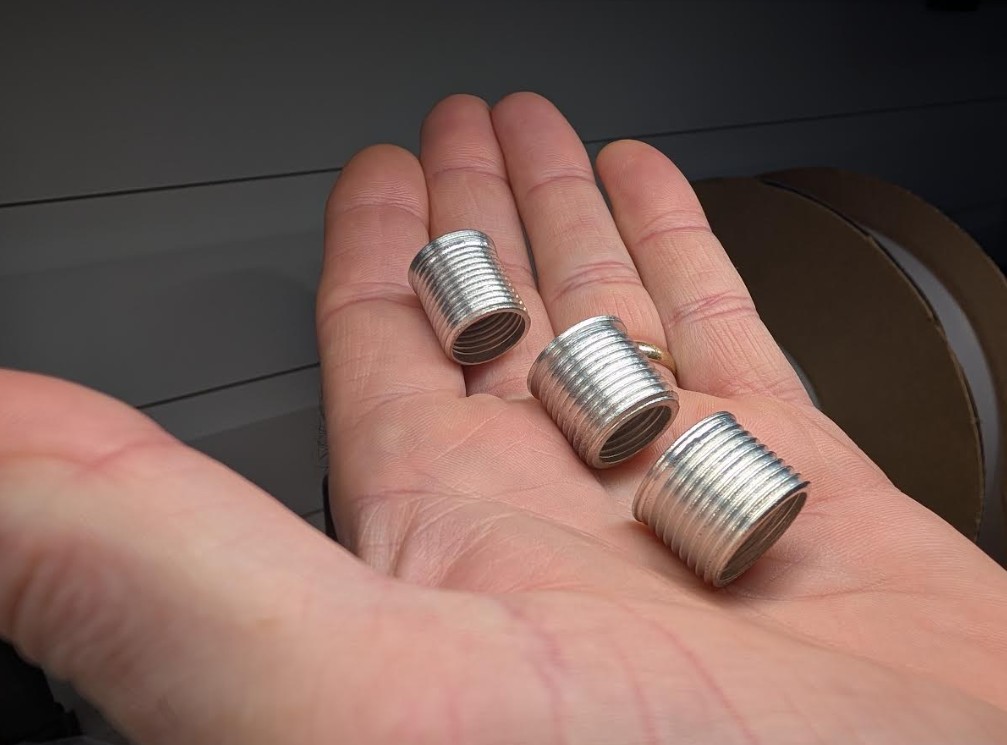
In the automotive repair world, a blown-out spark plug on a Ford 4.6L, 5.4L, or 6.8L Modular “Triton” engine is a classic headache. It’s a common issue that has spawned an entire industry of specialty thread repair kits.
Recently, a customer came in with a 2008 Crown Victoria (4.6L SOHC). They had a massive scare: a solid metal thread repair insert backed out of the cylinder head right along with the spark plug.
The customer measured the outside diameter (O.D.) of the failed insert at 0.55″ and assumed it was a Time-Sert 44186.
It’s a very common misconception. Because it’s a solid metal bushing (rather than a wire coil-style “Helicoil” insert), many DIYers and technicians instantly assume any failed solid insert must be a Time-Sert. However, a quick look at the actual physics and dimensions of these inserts shows why this is mathematically impossible—and highlights the serious dangers of trying to reinstall a backed-out insert.
The Math: Why a 0.55″ Insert is NOT a Time-Sert
Time-Sert is highly regarded for its precision engineering, but they do not make magic. For an M14x1.25 spark plug to thread inside a solid steel bushing, the wall of that bushing must have physical thickness.
To prove why a 0.55″ O.D. insert cannot be a Time-Sert, let’s look at the actual measurements:
- The M14 Spark Plug Thread: A standard 14mm spark plug has an outer major diameter of roughly 0.551″ (14mm).
- The Impossibility: If the customer’s failed insert measured 0.55″ on the outside of the threads, it is physically impossible for an M14 spark plug to fit inside it. An insert of that size would have walls as thin as paper, leaving zero room for outer threads.
Genuine Time-Sert Dimensions
Time-Sert designs its inserts with substantial wall thickness to handle the extreme heat and combustion pressures of the cylinder head. Their sizing works in distinct stages:
| Repair Stage | Time-Sert Part # / Kit | Outer Thread Diameter (O.D.) | Application Context |
| 1st Time Repair | 44186 (Standard M14x1.25) | 0.60″ | Used on a freshly stripped, factory-size hole. 4412E |
| Big-Sert (Oversize) | 51457 (Oversized M14x1.25) | 0.70″ | Replaces failed standard inserts (like standard Helicoils). 5553FL |
| Triple Oversize | 55522 / 5600 Kit | 0.78″ (M18x1.5 external) | The “last chance” repair. Requires a standard 51457 insert nested inside it. 5600 |
If the customer pulled out a solid insert measuring 0.55″, it was likely a cheap, under-engineered, thin-walled knockoff or a generic brand that did not provide proper thread depth or structural integrity.
The Reinstallation Temptation: A Critical Mistake
When an insert backs out on a spark plug, the immediate temptation for a vehicle owner is to clean it up, apply some thread locker, and thread the same insert back into the cylinder head.
Do not do this. In professional experience, re-installing a failed insert is a recipe for disaster.
Why Reinstallation Fails:
- Compromised Aluminum Threads: The only reason the insert backed out in the first place is because the aluminum threads in the cylinder head became loose, degraded, or stretched. Putting the same insert back into a wallowed-out hole ensures it will blow out again—often taking a chunk of the cylinder head with it next time.
- Loss of Mechanical Lock: High-quality inserts (like Time-Sert) use a cold-rolling installation process to flare and lock the bottom of the insert into the aluminum. Once an insert has backed out, that locking mechanism is permanently deformed and useless.
- Severe Head Damage: A repeat blowout usually tears away more aluminum, making the hole significantly larger and occasionally rendering the cylinder head completely unrepairable by standard oversized kits.
The Correct Professional Fix
If a first-generation insert has failed and backed out of a Ford 4.6L head, the correct path forward is to step up to an oversized repair system.
If the hole is still under 0.66″ in diameter, stepping up to a Time-Sert Big-Sert (using the 51457 insert with a 5553FL kit) is the gold standard. It will cut clean, larger-diameter threads into the head, and use the cold-rolling tool to permanently lock the new, larger steel insert into the head so it can never back out again.
Always measure twice with a digital caliper before buying a repair kit. Knowing the exact size of the failed hole ensures you buy the right kit the first time—and prevents a temporary patch job from turning into an expensive cylinder head replacement. If the hole is larger than .66